Home.About Us.Creations.Instruction.Publications.
Other places to visit

©Woolly Thoughts 2010          Contact Us          Site Map
INTRODUCTION TO ILLUSION KNITTING
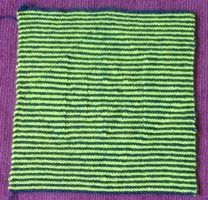
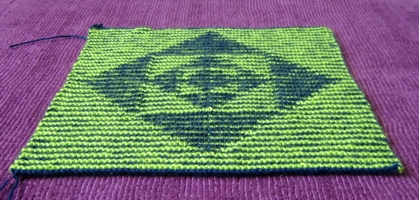
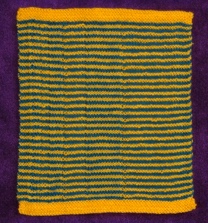
Illusion Knitting is also known as Shadow Knitting. When you look straight on to a piece of illusion knitting you see only two-colour stripes. A picture or pattern can be seen when you look from a different angle.

See Illusion Art for photos of completed pieces.

Illusion knitting is a simple technique, based on stripes in two colours, using knit and purl stitches to create special effects. It relies on careful counting and positioning of stitches. It is suitable for knitters of all abilities. You will find many descriptions of how to do illusion knitting and how to chart the designs. We believe that our charts are different from any others and are easier to follow, even when making a complex-looking design.

The photos below are examples of the simplest type of illusion knitting. They have one colour which is definitely a background and another which shows the design when viewed from the correct angle. The photographs show two views. One is what you see from straight in front of the piece, the other is when viewed from an angle.

* * * * * * * * *

Illusion knitting stripes are closer to garter stitch than they are to stocking stitch. Garter stitch ridges and stitches form a square grid and, in our experience, a design on a square grid works much better for illusion knitting than a normal stocking stitch (intarsia) grid. Designs intended for cross-stitch, tapestry, etc. Would work well.

We used our Square to Eternity design and overlaid it with a square grid.
This illusion is based on From Square to Eternity
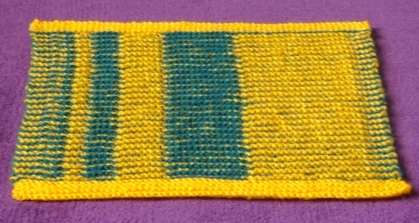
This illusion is based on the Fibonacci sequence of numbers
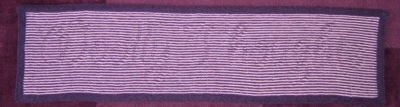
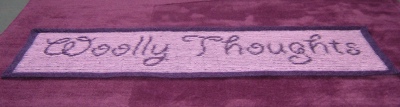
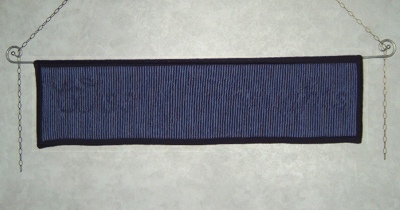
The photos below show two banners, using the basic illusion knitting methods. The same method is used for both but working in a different direction. One reveals the illusion when looked at from below; the other should be viewed from the side.
In illusion knitting, the stripes are in two colours and each stripe is made up of two rows. The right side of every stripe is knit, whichever colour is being used. You can completely forget about the right side rows as they are always plain knit.

All the action takes place on the second row of the stripe (which is the wrong side of the work). You only need a chart for the wrong side rows. On the chart, white stitches are purl, coloured stitches are knit, using the colour for the stripe you are working.

In this example the background was green and the design was to stand out in black. This is a very simple example. There are no knit stitches on the wrong side of the work in the green stripes. You can’t see any green on the grid because all the stitches are purl so are coloured white.

The results can be seen below. The photo on the left shows the design when you look down on it. It is possible to make out a very feint outline of the black squares if you look very carefully but the overall effect is of narrow stripes. The other photo shows what you see when you stand back from it.

In more complex designs there can be knit stitches on the wrong side in both colours. Harry Potter is an example of this but still all the right-side rows are knit.

We are experimenting to develop our ideas further.